Visitor economy
Auckland as a destination
Composition of tourism expenditure

Auckland - monthly guest nights
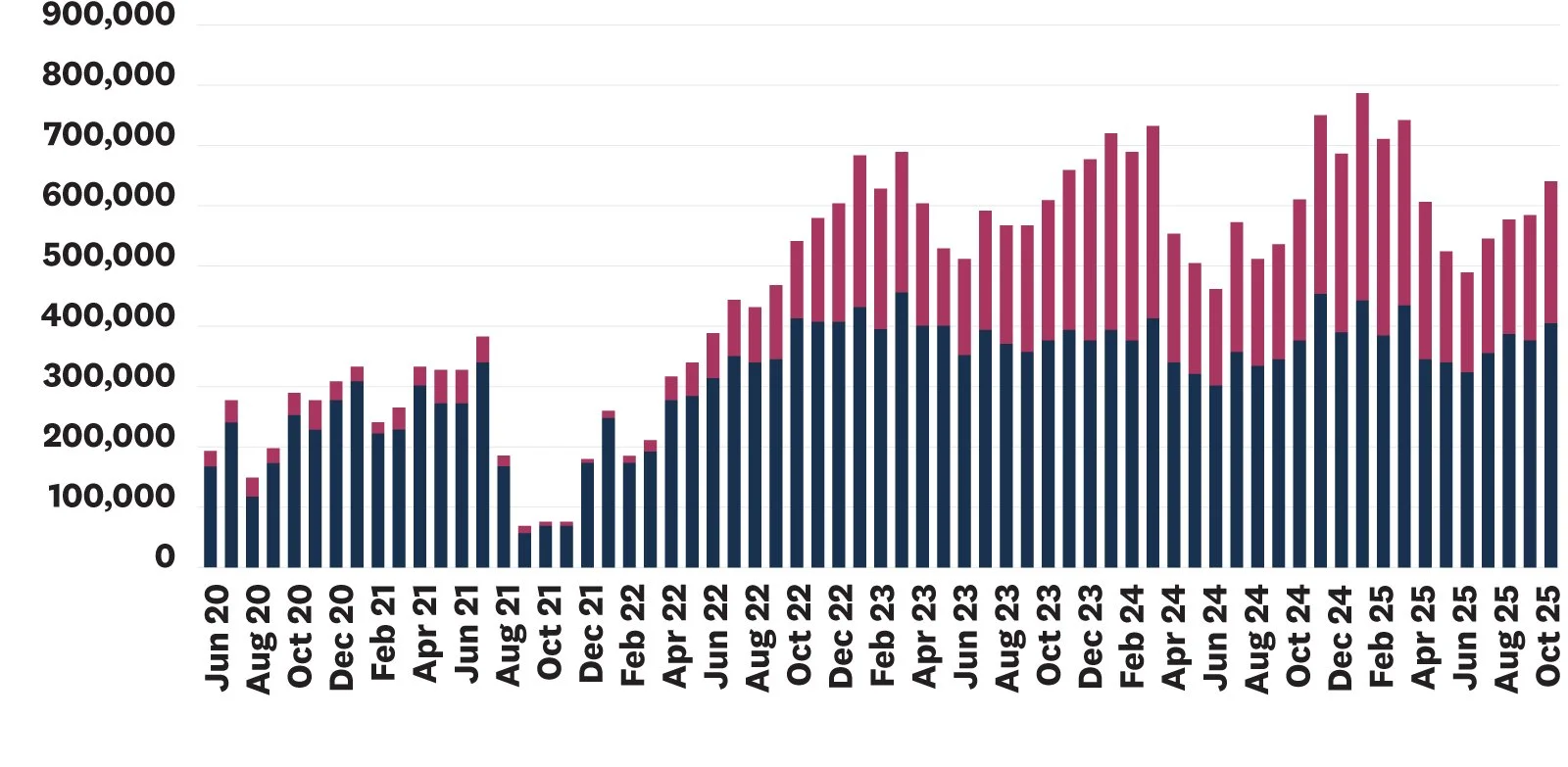
Auckland’s visitor economy strengthened in 2025-26, with guest nights increasing and the international share of tourism expenditure rising significantly, although domestic visitors continue to account for the majority of spending.
Auckland’s visitor economy continued to strengthen in the year to August 2026, with total guest nights reaching 8.39 million, up 11.3 per cent from the year to August 2025. Domestic guest nights increased by 9.3 per cent to 5.03 million, while international guest nights rose more strongly, by 14.4 per cent to 3.35 million. This indicates that growth in Auckland’s visitor economy was supported by both domestic and international demand, with international visitors making the stronger contribution to growth.
At the same time, the composition of visitor spending shifted further back towards international visitors. In the year to March 2026, international visitors accounted for 43 per cent of Auckland’s tourism expenditure, up significantly from 37 per cent in 2025. This shift reflects the continued recovery in international visitor spending following the pandemic period. International passenger movements in and out of Auckland Airport for the year to July 2026 were at 94 per cent of pre-pandemic levels.
The continued recovery of Auckland’s visitor economy reflects its broader appeal as a destination. The State of the City 2025 and 2026 reports highlight Auckland’s culture as an important driver of its visitor economy, supported by a diverse, high-quality food and hospitality offering and creative strengths across architecture and film.
Auckland’s combination of urban lifestyle, culture, events and easy access to diverse natural landscapes, further broadens its appeal. Together, these attributes contribute to a distinctive and increasingly compelling visitor proposition.
The report also finds that visitor expectations are increasingly being met and perceptions of Auckland’s cultural offer have strengthened, while broader perceptions of visitor attractiveness and urban aesthetics have weakened.
This suggests an opportunity to better translate Auckland’s underlying strengths into a more visible and compelling destination experience.
-
There were 2.39m international visitor arrivals to Auckland in the year to August 2026.
This is an increase of 4.8% from 12 months ago.
Auckland recorded 8.39m guest nights in the year to August 2026, an increase of 11.3% on the previous year.
Domestic visitors account for around 60% of guest nights, with 5.03m compared with 3.35m for international visitors.
Both domestic and international visitors contributed to the annual increase. Domestic guest nights increased by 9.3% and international guest nights 14.4%.
-
43% of tourism expenditure came from international visitors in the year to March 2026.
This is a significant increase from the previous two years, reflecting the ongoing recovery of international tourism. (Note that the historical data has been updated since previous versions of this publication).
This is a larger proportion than the rest of New Zealand, which has a greater proportion of domestic visitor spending.
Total spending by international visitors increased by 43.1% in the year to March 2026, which is greater than the increase in international arrivals.
Compared to the rest of New Zealand, visitor spending in Auckland is more concentrated in ‘retail sales’ (excluding fuel and groceries) and ‘cultural, recreation and gambling services’, but less in ‘accommodation’ and ‘passenger transport’.
Sources: Number of visitors – TAU: Monthly Auckland Destination. Composition of tourism expenditure, spending patterns – Infometrics: Regional Economic Profile. Auckland guest nights – Fresh Info Accommodation Data Programme (ADP)
Economic impact of visitor economy
Economic contribution of visitor economy to Auckland
Source: Infometrics: Regional Economic Profile
Auckland’s visitor economy continues to strengthen, supported by rising visitor expenditure and the region’s role as New Zealand’s principal international gateway.
Tourism contributed $6.5 billion to Tāmaki Makaurau Auckland’s GDP in the year to March 2025 and employed over 57,000 people. While these figures remain nearly 20 per cent below pre-pandemic levels, they do not fully reflect the current recovery given they do not capture the growth in visitor expenditure and international visitor arrivals seen in the year to March 2026.
Auckland’s visitor economy benefits from its position as New Zealand’s principal international gateway. The State of the City 2026 reports that Auckland accounts for 73 per cent of the country’s international passenger movements, giving the region access to a substantial flow of international visitors. However, Auckland does not yet convert this gateway role into visitor expenditure to the same extent as some comparable international cities, capturing only 35 per cent of New Zealand’s international visitor expenditure.
Tāmaki Makaurau has significant potential to convert its strong visitor flows into greater economic value. Auckland’s city centre is New Zealand’s largest and fastest-growing hotel market, while growing accommodation capacity and a strengthening business events profile provides further opportunities to increase visitor spending.
-
The tourism industry employed 5.9% of Auckland’s workforce in 2025.
This is lower than the rest of New Zealand (7.7%).
Auckland’s tourism industry employed 57,000 people in the year to March 2025.
This remains below the 70,700 people employed in 2019 (-19%).
New Zealand’s tourism industry excluding Auckland employed 137,500 individuals, which remains 8.3% below pre-pandemic levels.
-
The tourism industry contributed 3.9% of Auckland’s total GDP in the year to March 2025.
This proportion is up slightly since 2024 (3.8%).
This proportion is lower than the rest of New Zealand (4.3%).
In 2025, tourism in Auckland contributed $6.5bn to real GDP, a <1% increase from 2024.
The rest of New Zealand’s tourism industry contributed $11.5bn to GDP, a 1.7% decrease from 2024.
Auckland’s tourism GDP remains around $13.bn below its pre-pandemic value.
-
Tourism expenditure growth was heavily concentrated in Auckland, which recorded a 20.6% increase compared with 1.6% across the rest of New Zealand.
Domestic visitor spending continues to have the greater proportion of tourism expenditure at 56.6 per cent ($3.18bn), despite international spending seeing a sizeable increase over the past year.
*Tourism expenditure data has been revised since the previous Auckland Economic Monitor to reflect MBIE’s redeveloped Monthly Regional Tourism Estimates (MRTE) series. The current MRTE series uses a revised methodology and is not directly comparable with the discontinued data.
Auckland Economic Monitor
A summary of key economic information about the region
Auckland’s economy
-
![Economic activity]()
Economic activity
While Tāmaki Makaurau Auckland’s economy continued to grow in the year to March 2024, provisional estimates show a slight decline in economic output over the last 12 months.
-
![Businesses]()
Businesses
GDP output per worker (labour productivity) in Tāmaki Makaurau Auckland fell (in real terms) -0.7 per cent in the year to March 2024 and has likely stagnated or declined slightly in the year to March 2025.
-
![The labour market]()
The labour market
Tāmaki Makaurau Auckland’s workforce is growing, and continues to become more diverse and skilled.
-
![Economic confidence]()
Economic confidence
Tāmaki Makaurau Auckland's consumer confidence has fluctuated over the last 12 months, as part of a complex - yet promising - trend in sentiment.
-
![Visitor economy]()
Visitor economy
Tāmaki Makaurau Auckland offers the first taste of New Zealand for many international visitors. International tourism has recovered strongly, but it is not yet back to pre-COVID-19 levels.
-
![Community]()
Community
Tāmaki Makaurau Auckland is a young, diverse and growing region. It is home to 34 per cent of New Zealand’s population.
-
![]()
Emissions
Tāmaki Makaurau Auckland's ongoing efforts to manage and reduce emissions are part of its commitment to a greener and more sustainable future.